Friday, 8 July 2011

The Opening of the Manchester Ship Canal A.D. 1894

A woman dips her feet into the ocean as seagulls hover above and children play with a bucket and spade. On closer inspection, we realise that the woman is sitting on a warehouse and that in the background there is a dark industrial scene of chimney stacks billowing smoke into the air. Punch's satirical cartoon, dated 7th October 1882, has the caption MANCHESTER-SUR-MER: A SEA-DUCTIVE PROSPECT. Just over eleven years later – at was then a staggering cost of £15,000,000 – this seemingly ridiculous idea was to become reality. The Manchester Ship Canal was the engineering achievement of its time, the largest navigation canal in the world, transforming a land-locked city into an important sea-trading hub. When we look at a satellite image of the North West of England today, we can clearly see the canal cutting through great swathes of land in unnaturally straight lines from the Mersey Estuary to Salford Quays where it meets the Irwell (as the Mersey itself meanders insignificantly alongside). In terms of the Ascent of Manchester, this is a key moment, allowing the city to diversify into the shipping industry at Liverpool's expense (exacerbating what was already a bitter rivalry between the two cities) and ensuring greater independence in what was to be a period of increasing uncertainty.


In 1855 Manchester had 1,724 warehouses and only 95 cotton mills. This reflected its position as the trading centre for goods produced in the surrounding towns of South-East Lancashire (Bolton, Bury, Rochdale, Oldham, Stockport) and East Lancashire (Burnley, Accrington, Blackburn) further north. The Manchester – Liverpool axis was still of vital importance for importing raw cotton and exporting manufactured goods through the Port of Liverpool. Since the opening of the Liverpool and Manchester Railway in 1830, this had mainly been done by train with the goods yards in Liverpool Road Station surrounded by warehouses and canals. Manchester had survived the Lancashire Cotton Famine of 1861 – 1865, during which large scale public works were commissioned by local government to reduce unemployment, but the lean years had shown just how fragile the Cottonpolis economy really was, a dark omen for the future of what was still the world's largest industrial city.


By the 1870s, with dues charged by the Port of Liverpool and what were considered excessive railway charges, it was often cheaper to import goods from Hull than it was from Liverpool. On 27th June 1882, the manufacturer Daniel Adamson arranged a meeting at his home in Didsbury to discuss the possibility of building something like the Suez Canal (which had opened on 17th November 1869 after ten years of construction) to by-pass Liverpool and gain direct access to the sea. The meeting was attended by 68 people, including the mayors of Manchester and the surrounding towns, leaders of commerce and industry, bankers and financiers. A bill was submitted to Parliament in November, to much amusement in the rest of the country (and possibly great alarm in Liverpool). It faced intense opposition from railway companies and the Port of Liverpool but was finally passed on 6th August 1885. This was clearly a group of people for whom there was a belief that anything was possible. If the Art Treasures Exhibition of 1857 had been a global exercise in boosting civic pride, this was a daring example of ruthlessness from Manchester's business elite.


It took nearly two years to raise the money and on 15th July 1887, a prospectus for the sale of preference shares in the company had to be issued jointly by Barings and Rothschild. A week later the project was underwritten. Lord Egerton of Tatton, the chairman of the board of directors of the Manchester Ship Canal Company, cut the first sod on 11th November 1887 as construction began on what was to be a huge and complex engineering project. After four years the canal company had exhausted its already considerable funds of £8,000,000 – with only half the project complete. To avoid having to declare bankruptcy, they appealed to the Manchester Corporation to bail them out. On 9th March 1891 the Corporation agreed to lend the £3,000,000 necessary to finish the project and preserve the city's prestige. On 14th October they would have to lend a further £1,500,000 as estimates for the costs of completion rose. The canal was finally completed in November 1893 and opened to traffic on New Year's Day.


On 14th May 1894 Blackpool Tower was opened. Along with the Royal Liver Building in Liverpool (1911) and the Beetham Tower in Manchester (2007), it was to become one of the North West of England's three landmark pieces of architecture, and a symbol of the rising popularity of the seaside resort as a destination for workers and their families. A week later, on 21st May, Queen Victoria visited Manchester to perform the official opening of the Manchester Ship Canal. In terms of the amount of material that had been excavated during construction, it was around half the size of the Suez Canal (the world's most important trade route). At first the traffic predicted for the canal failed to materialize as the shipping cartels based in Liverpool watched and waited, and for a while it must have looked like this expensive project was a huge white elephant – perhaps in the end it was. Manchester's business community certainly benefitted from the Ship Canal as the Liverpool-based cartels were forced to lower their prices. But the Canal itself only began to achieve its full potential with the establishment in 1898 of the Manchester Liners who were able to offer a range of transatlantic shipping routes. The arrival of the Middlesbrough-built 'Manchester City' (designed to carry frozen meat and live cattle) was a cause for celebration when it became the first large vessel to enter the terminal docks. The Manchester Guardian reported on 16th January 1899 that 'there were many shakings of the head, not only in Liverpool, at the audacity of the attempt.'


The area around the Port of Manchester and the Manchester Ship Canal became a focus for further industrialisation and modernisation, providing jobs for workers from the surrounding districts of Ordsall, Salford, Old Trafford and Moss Side as the city continued its rapid expansion. At the turn of the century, Trafford Park was the largest industrial estate in Europe and it's hard to imagine this being the case if the Ship Canal hadn't been built. Manchester was the birthplace of trade unionism and had hosted the first meeting of the TUC in 1868 but its workers had jobs and relative prosperity. The city had gone from being dominated by warehouses and commodity exchanges to a major international shipping centre, just as Liverpool and the cotton manufacturing towns of East Lancashire were beginning to enter into decline. Its workers were now enjoying the radical concept of 'leisure time' – time spent at the seaside with their families or watching one of the region's many football teams. The Football League had been founded in Manchester in 1888 by teams from Lancashire and the Midlands. Manchester United won their first league title in 1908, their first FA Cup in 1909 and on 19th February 1910 played their first match at their new stadium in Old Trafford near the Port of Manchester. Strangely enough, considering the impact the idea of Manchester-on-Sea had had since Daniel Adamson's meeting nearly thirty years earlier, the match was against Liverpool (who won 4-3).


Manchester United's links with the Port of Manchester and Trafford Park evolved naturally from its support base amongst the dockworkers of Salford, Ordsall and Old Trafford. Interestingly its fortunes are linked with the subsequent history of the Ship Canal. The area was heavily bombed during World War II, such was its strategic importance to the Allies. After the war, the Ship Canal was to reach its hey-day in the fifties and sixties as Manchester United went on to become the first English team to compete in Europe in 1957 and the first English team to win the European Cup in 1968. Ultimately the Manchester Ship Canal could not remain competetive following the growth of container ports in the 1970s and the arrival of the much larger ships that were being built. The world was becoming increasingly globalized as manufacturing jobs were outsourced to countries in the Far East such as China and Vietnam. The huge container ships that we see today are the symbol of the new globalization and the decline of the Manchester Ship Canal. Their rise coincides not only with the technological revolution and the age of satellite TV and the internet but also with the Manchester United's success under Alex Ferguson since his managerial appointment in November 1986. A hundred years after the Ship Canal was first opened to traffic, Manchester United became the first team to win the English Premier League – the globally successful franchise that has grown in popularity along with the club itself. The Ship Canal is owned by Peel Holdings who have long had plans to regenerate the route. More significantly, the area around Old Trafford and Salford Quays is now served by the Metrolink and is home to thriving office space and property developments, the Lowry (1999), the Imperial War Museum North (2002) and – nearly 130 years since Daniel Adamson first raised the idea of Manchester-on-Sea – the MediaCity:UK development which will soon be home to the BBC (2011).

Thursday, 7 July 2011

Abraham Lincoln addresses the working people of Manchester A.D. 1863

There is a Victorian polemic which apparently reads something like this: 'Athens, Florence, Manchester: there is no fourth.' And at the time there probably wasn't. Here we have the three stages of Western Civilisation: Ancient Greece and Rome, the Renaissance and the Industrial Revolution. Whether or not we agree with it – and I'm sure there are many who wouldn't – the polemic illustrates the confidence Manchester now had in itself. Perhaps the years 1857 – 1913 can be seen as the city's golden era. It begins with the Art Treasures Exhibition and the formation of the Hallé Orchestra and ends with the peak year for the global cotton trade – just before World War I signalled the beginning of the end for the British Empire.

This confidence and prosperity is also reflected in the city's architecture of the period: The Free Trade Hall (1855), Watts Warehouse (1856), Strangeways Prison (1868), Church of the Holy Name (1871), Barton Arcade (1871), The Reform Club (1871), The Spanish and Portuguese Synagogue (1874), The Royal Exchange (1874), Manchester Town Hall (1877), Manchester Central Railway Station (1880), The Palace Hotel (1895), The Great Northern Warehouse (1898), John Rylands Library (1900), Whitworth Hall (1902), Victoria Station (1902) and The Midland Hotel (1903) are all built within fifty years of each other.

Many important national institutions and sports clubs date back to this period. The Manchester Mechanic's Institute hosts the first meetings of the Co-operative Insurance Society (CIS) in 1867 and the Trades Union Congress (TUC) in 1868. When it is re-opened it 1874, the Manchester Royal Exchange is described as 'the biggest room in the world.' Newton Heath L&YR Football Club (later Manchester United) are formed in 1878. In the same year, 28,000 spectators watch Lancashire play W.G. Grace's Gloucestershire over three days at Old Trafford Cricket Ground. St. Mark's Gorton Football Club (later Manchester City) are formed in 1880, the same year Owen's College becomes Victoria University. A cheque for £1,700,000 (dated 3rd August 1887) for the purchase of the Bridgewater Navigation Company by the Manchester Ship Canal Company is the largest that has ever been presented. The Football League is formed at the Royal Hotel in Manchester on 17th April 1888 and the first Marks & Spencers store opens on Cheetham Hill Road in 1893.

The city was getting bigger and would almost treble in size in the space of fifty years. The German business community was affluent enough to help fund the Hallé Orchestra in its early years. For the Irish immigrants however, many of whom had arrived following the Great Potato Famine of 1845, the situation was desparate – as it had been for some years. There were also families of Italians living in the cellars of Ancoats and the Jewish community was about to embark on its historic migration from Cheetham Hill to Higher Broughton to Prestwich and Whitefield. A European melting pot of Germans, Jewish, Irish and Italians, even though it had no docks, late Victorian Manchester was probably the least English of cities.

If the architecture of Alfred Waterhouse was beginning to dominate the city's skyline, this was also the time when Manchester began its close association with the Pre-Raphelites, whose paintings were bought by rich industrialists and can still be seen today in the Manchester Art Gallery. The city was keen to change its image as an unpleasant, dark and smoky place dedicated solely to manufacturing. The Art Treasures Exhibition, which took place over a three-acre site at Old Trafford, was a key step towards this. Opened by Prince Albert on 5th May 1857, it ran until 17th October but was closed for one day to mark a 'day of humiliation' on account of the Indian Mutiny. There were over 16,000 works on display and is probably the largest arts exhibition ever held. High profile visitors included the King of Belgium, the Queen of the Netherlands, Louis Napolen, Benjamin Disraeli, William Ewart Gladstone, Charles Dickens, Alfred Lord Tennyson, Florence Nightingale, John Ruskin, Nathaniel Hawthorne and, on 29th June, even Queen Victoria herself. Friedrich Engels wrote to Karl Marx saying, “Everyone up here is an art lover just now and the talk is all of the pictures at the exhibition...”

Historian Tristram Hunt has said that 'Manchester that summer was the centre of the western world.' The exhibition was indeed a huge success. In the 142 days it was open it attracted over 1,300,000 visitors, many on organised rail excursions. Titus Salt commissioned three trains to transport 2,600 of his factory workers from Saltaire to visit on 19th September. Thomas Cook organised 'moonlight' excursions from Newcastle, leaving at midnight and returning late that evening. An orchestra was set up by Charles Hallé which gave daily performances. This formed the basis for the Hallé orchestra who gave their first concert on 30th January 1858 and were to be based at the Free Trade Hall for many years to come.

On 6th March 1857, just two months before the Arts Treasures Exhibition was opened in Manchester, a ruling was handed down by the U.S. Supreme Court in the case of Dred Scott v. Sandford, that people of African descent brought into the United States and held as slaves were not protected by the Constitution and could never be U.S. citizens. Furthermore, the Court ruled that slaves, as chattels or private property, could not be taken away from their owners without due process. On 16th June 1858, upon accepting the Republican nomination as the Illinois candidate for the U.S. Senate, Abraham Lincoln addressed delegates with the following words:

A house divided against itself cannot stand. I believe this government cannot endure, permanently, half slave and half free. I do not expect the Union to be dissolved — I do not expect the house to fall — but I do expect it will cease to be divided. It will become all one thing or all the other. Either the opponents of slavery will arrest the further spread of it, and place it where the public mind shall rest in the belief that it is in the course of ultimate extinction; or its advocates will push it forward, till it shall become alike lawful in all the States, old as well as new — North as well as South.

Lincoln was to lose the Senate race but his speeches and debating skills gave him a national reputation as an opponent of the expansion of slavery. He won the Republican nomination and, on 6th November 1860, was elected the sixteenth president of the United States, winning support in the industrial north (where slavery had already been abolished). Rallying around the idea that 'Cotton is King', eleven slave states in the south seceded to found the Confederate States of America, thus beginning the American Civil War of 1861 – 1865.

The Confederates thought that their strategic importance as the UK's main Cotton supplier would allow them to survive financially as an independent country and win military support in their war with the Union. The British remained neutral in the war but there were many who argued that they should support the south and a massive diplomatic effort was launched to further this aim, with its headquarters at Rumford Place in Liverpool. The Union naval blockade of the southern ports meant that Cotton could no longer be exported, causing a huge rise in unemployment as Lancashire's millworkers went from being the most prosperous to the most impoverished in the country. Despite this, there seems to have been widespread support amongst the workers of Manchester who, on 31st December 1862, met at the Free Trade Hall and resolved to support the Union in its fight against slavery. This was expressed in a letter from 'the Working People of Manchster' to Abraham Lincoln:

... the vast progress which you have made in the short space of twenty months fills us with hope that every stain on your freedom will shortly be removed, and that the erasure of that foul blot on civilisation and Christianity – chattel slavery – during your presidency, will cause the name of Abraham Lincoln to be honoured and revered by posterity. We are certain that such a glorious consummation will cement Great Britain and the United States in close and enduring regards.

In his reply, dated 19th January 1863, Lincoln thanked them for their support:

... I know and deeply deplore the sufferings which the working people of Manchester and in all Europe are called to endure in this crisis. It has been often and studiously represented that the attempt to overthrow this Government which was built on the foundation of human rights, and to substitute for it one which should rest exclusively on the basis of slavery, was unlikely to obtain the favour of Europe.

Through the action of disloyal citizens, the working people of Europe have been subjected to a severe trial for the purpose of forcing their sanction to that attempt. Under the circumstances I cannot but regard your decisive utterances on the question as an instance of sublime Christian heroism which has not been surpassed in any age or in any country. It is indeed an energetic and re-inspiring assurance of the inherent truth and of the ultimate and universal triumph of justice, humanity and freedom.

I hail this interchange of sentiments, therefore, as an augury that, whatever else may happen, whatever misfortune may befall your country or my own, the peace and friendship which now exists between the two nations will be, as it shall be my desire to make them, perpetual.

The Confederacy was defeated on 9th April 1865 ending the war and the cotton trade soon returned to its previous levels. Six days later Abraham Lincoln was assassinated at Ford's Theatre in Washington D.C. Remarkably, The Manchester Guardian which had been hostile to the Unionist cause, published an editorial on 27th April that was extremely critical of the dead president: 'Of his rule, we can never speak except as a series of acts abhorrent to every true notion of constitutional right and human liberty.' It's very difficult now to even comprehend such a position. Perhaps nearly 150 years has given us a clearer perspective on events but this ought to go down as the most shameful episode in the publication's history. Abraham Lincoln went on to become recognised as the greatest U.S. President and his links with the working people of Manchester (who were on the right side of the historical argument, even when it didn't suit them to be) are commemorated by a statue on Lincoln Square on Brazennose Street, linking the Town Hall with Deansgate.

The Abolition of the Corn Laws A.D. 1846


The demand for universal suffrage was not the only reason 60,000 people attended the demonstration that led to the Peterloo Massacre on 16th August 1819. They wanted representation because they were hungry. During the Napoleonic wars, British agriculture had experienced a boom as the British market was effectively closed to cheap grain imports from mainland Europe. This came to an end when Napoleon was defeated in the Battle of Waterloo in 1815. As the prospect of foreign competition returned, pressure mounted on Parliament to come up with a means of sustaining the good times for British farmers. The Corn Laws were introduced to this effect, imposing a duty on imported corn, a policy known as 'protectionism.' With the price of bread set at an artificially high level (to keep British farmers happy), workers in Manchester and the surrounding towns struggled to be able to afford to eat – especially when harvest failure caused a reduction in supplies. This was one of the main reasons the city was gaining a reputation for political radicalism, what with Peterloo and the demonstrations that had attended the Duke of Wellington's arrival on board the Liverpool and Manchester Railway in 1830.


The new urban middle class took an equally strong interest in this issue (even though they themselves were able to afford bread). The Anti-Corn Law League was founded in Manchester in 1838 by millowners Richard Cobden and John Bright with the aim of campaigning peacefully for the abolition of the Corn Laws. They advocated a policy of 'free trade': by removing the duties on imports, increased competition would drive down the price of bread. Rural landowners (those who stood to lose out over the changes) claimed that the millowners would use this as an excuse to lower wages and maximise profits. [On the opposite end of the political spectrum, Karl Marx was amongst those who agreed with this interpretation.] The 'free traders' argued that this was too simplistic; that it was not in their interests to reduce wages further; that the lowering of food prices would result in an increase in disposable income thus stimulating greater demand for the products being made in the factories. Industry, they claimed, was being suffocated by the Corn Laws.


Cobden (an Anglican from Sussex/Hampshire who had moved to Manchester in 1832 to work in the textile industry) and Bright (a Quaker from Rochdale who was renowned as a great orator) were elected to Parliament in 1841 and 1843 respectively and represented a formidable alliance. The now highly influential newspaper The Economist was founded in September 1843 to promote free trade and support the Anti-Corn Law League. In November of that year, The Times startled their readers by declaring in a leader that, 'the League is a great fact. It would be foolish, nay, rash, to deny its importance.' Prime Minister Robert Peel claimed to support the idea of free trade but voted against repealing the Corn Laws. His hand was forced by the impact of the the Irish Potato Famine in 1845, and the Corn Laws were abolished in 1846 to much fanfare from the Manchester Guardian. It was hailed by The Manchester Guardian as 'a decisive triumph of the principle of free trade.' Cobden and Bright were paraded as the heroes of Manchester's new middle class. In the years that followed, they maintained a consistent philosophy of 'small government' economics and principled anti-war liberalism even when this proved unpopular with general opinion.


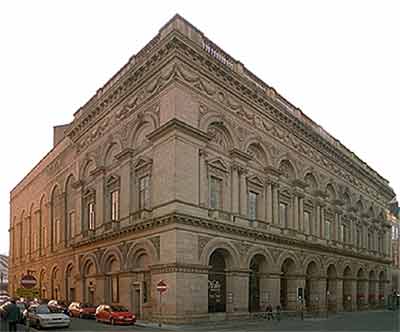
The Free Trade Hall was built in 1853-1855 on the site of the Peterloo Massacre as a monument to the success of the Anti-Corn Law League. Although it has now been turned into a five star hotel, it still resonates as an enduring symbol of Manchester's political journey from Peterloo (1819) to the Abolition of the Corn Laws (1846). But there is a dichotomy here between two ideals: one – free trade – represents the urban middle class (of whom Cobden and Bright were the main spokesmen). The other represents the urban working class, the people who were massacred at Peterloo (while the middle class stood by and did nothing) and who had violently protested the Duke of Wellington's arrival on board the Liverpool and Manchester Railway in 1830. On 24th September 1838 the biggest of the Chartist rallies was held on Kersal Moor, two miles to the north of Manchester, and attended by a crowd of 30,000 (or many more depending on various estimates). There was anger at the restriction of the franchise to men of property, a lack of democratic representation for working men and women. The people didn't just want bread, they wanted the vote. It was into this turbulent atmosphere that a thoughtful and well-read young German businessman first arrived in the city in 1842. His friendship with the man would come to be considered one of the great intellectuals of his time would have a dramatic effect on world history in the years to come.


The scene many people associate with Manchester in the 1840s is that of Karl Marx and Friedrich Engels huddled in the library at Chetham's, working on the Communist Manifesto. The scene is appealing on a number of levels. It combines old Manchester (opened in 1653, Chetham's is the the UK's oldest public reference library) with its Victorian status as the world's foremost industrial city and the birthplace of capitalism and a completely new class system. It has an almost surreal emotive appeal, one of the few places in the world where we can place the two men at the same time. In his book about the North of England, Pies and Prejudice, Stuart Maconie describes being taken to Chetham's Library on the tour of radical Manchester and being told by his guide that hardened Chinese Communist Party officials had wept when they took down books on economics from the shelves that Marx and Engels would have read. A 22-year-old Engels had arrived in the city from Berlin. Already a radical thinker, he became fascinated by the unstoppable phenomenom that was Manchester in the 1840s, the city which historian Simon Schama has described as, “the very best and the very worst taken to terrifying extremes, a new kind of city in the world; the chimneys of industrial suburbs greeting you with columns of smoke.' In 1844 Engels' Die Lage der arbeitenden Klasse in England was published in Germany and it is in this context that the unqualified success of the Anti-Corn Law League should be placed. Ultimately the free traders wanted a more unrestrained form of capitalism and there were those who saw this a movement towards further exploitation. Marx would visit his friend and benefactor in Manchester and the two would share their ideas. But whilst there is resonance to the image of Marx/Engels sitting at the window of Chetham's Library – overlooking what would now be a wide open space, crowded with skateboarders, and the Urbis building – discussing the plight of the workers, it is an overly sentimental version of an extremely complex time in the city's history. There is something almost shameful about Marx's ambivalence towards the success of the Anti-Corn Law League. It is almost as if he saw the moment as a lost opportunity, that if the workers were starving then they would be more receptive to the idea of a revolution. In 1848, the year the Communist Manifesto was published, there were large-scale demonstrations throughout Europe, but Britain was largely unaffected by what must have seemed a tidal wave of revolution, and it is to the credit of the Anti-Corn Law League that this was the case. Marx would go on to write Das Kapital (1867) in the British Library in London but the workers of Lancashire were famously uninterested in his critique of the capitalist society. Harold Wilson would later claim that the labour movement in Britain owed more to Methodism than Marx.

Wednesday, 6 July 2011

The opening of the Liverpool and Manchester Railway A.D. 1830


Manchester had grown considerably since the invention of the Flying Shuttle, patented by John Kay of Bury in 1733, and the opening of the Bridgewater canal in 1761 (to transport coal from Worsley). The first Spinning Jenny was built in 1764 by James Hargreaves of Standhill (near Blackburn), making the process of hand-loom weaving many times more productive. Demand for woven goods, now cheaper, increased, causing a shift in employment patterns away from agriculture. However this was still largely a cottage industry meaning we did not yet see mass migrations of people to the towns and cities to find work. In 1771 Cromford Mill was opened in Derbyshire, one of the first factories built to house machinery as opposed to just people. Built on the river Derwent, a water wheel was used to power the spinning frame (based on a design by millowner Richard Arkwright of Preston and a different John Kay of Warrington). However the most revolutionary innovation of the period was the Spinning Mule, invented by Samuel Compton of Hall i'th' Wood, Bolton in 1779, which used steam power rather than water. This meant that mills could be built anywhere where there was a good supply of labour and coal. Now it made sense to build large mills in the same place and concentrate the workforce there, creating incentives for people to move away from their families in the countryside and into the newly industrialised towns and cities to look for better paid work.


The Rochdale canal was opened in 1804 and Manchester, the largest market town in the region, grew as the centre for trading the cotton goods (commodities) produced in surrounding areas. Huge warehouses were built overlooking the meeting point of the two canals in the Castlefield basin (near Deansgate locks). Ancoats became the world's first industrial suburb. There were sporadic outbreaks of organised violence as hand-loom weavers destroyed machinery which they perceived as a threat to their livelihood. Whereas traditionally weavers had used flax and wool to produce textiles, cotton (grown in very warm and dry climates) proved a more durable and comfortable alternative. To meet the demand for raw cotton, American plantation owners in the deep south were using slave labour for the most mundane and backbreaking tasks of the cotton picking fields. It would then be shipped from New Orleans to Liverpool where it was transported by canal or horse-drawn cart to the buyers in Manchester who sold it on to the factories in the surrounding areas. Here it would be carded, spun and produced into textiles (or cloth or fabrics – incidentally, the Polish word for factory is fabryka). These manufactured cotton goods were then taken back to the warehouses in Manchester (from surrounding towns such as Bolton, Bury, Rochdale, Oldham, Ashton-Under-Lyne, Stalybridge, Stockport and as far afield as Accrington, Burnley, Blackburn and Preston). On top of the domestic demand for Manchester's cotton goods, there was also a massive interenational market accessible through the Port of Liverpool.


The Manchester – Liverpool axis was of crucial importance for the international cotton trade and it is no surprise that the greatest transport innovation of the period was pioneered here. The steam engine had been by revolutionized by Scottish engineer James Watt's designs in 1763. As we have seen, this was then applied to textile manufacture (Compton's Mule of 1779) and it was also used in deep mining for coal. But perhaps the most important application of steam power was the invention of George Stephenson's steam rail locomotive in 1814. The first steam railway was opened between Stockton and Darlington in 1825, a distance of 11 miles, however it was only used to carry coal and did not present any major engineering challenges. Of far greater significance was the world's first passenger railway system, the Liverpool and Manchester Railway, which covered a major trade route with a distance of over 30 miles. It was financed by a group of merchants from both cities (whilst Manchester was technically still a town at this point, it was in reality more of a bustling metropolis). After years of debate about the route permission was finally granted by parliament in 1826 to build the line. Construction took around three years and Stephenson had to overcome some engineering problems (crossing the unstable peat bog of Chat Moss, and building a nine-arched viaduct across the Sankey Valley and a two-mile long rock cutting at Olive Mount). The Rainhill trials were held in October 1829 and George Stephenson's Rocket was chosen to cover the route.


The line was opened on 15th September 1830, at a time when Britain was in the midst of one of the biggest political upheavels in its history. Electoral reform had been a major issue in the elections that year and the Reform Bill was about to begin its passage through Parliament (see Peterloo). The opening day was a major event and many politicians and dignitaries were in attendance, including the Prime Minister, the Duke of Wellington (famous for having commanded British forces at the Battle of Waterloo in 1815). But the festivities were marred with tragedy when William Huskinsson, the MP for Liverpool, was run over by Stephenson's Rocket as he was talking to the Prime Minister. The Duke's train was detached and the injured Huskinsson taken to Eccles where he later died in the vicarage. After the delay, a subdued procession made its way to Manchester but on arrival the Prime Minister was forced to stay on board the train because an angry mob had begun pelting it with missiles in protest against his opposition to electoral reform. Without alighting, the train returned to the relative safety of Liverpool in what must have been a humbling experience for the PM. The events of a dramatic and historic opening day were widely reported by the newspapers throughout Europe.


The line was a huge commercial success transporting 445,000 passengers in 1831. Receipts were £155,000 with profits of £70,000. By 1844 (when the passenger service re-routed to Victoria Station), receipts had reached almost £260,000 with profits of £135,000. Shareholders received a good return on their investment and Manchester was able to expand even further. The age of steam had arrived. By 1843 there were 2,000 miles of railway in England. This had increased to 5,000 miles by 1848 and was to exceed 23,000 by the end of the century. In addition to its evolving landscape of factories, warehouses and canals, Manchester (or 'Cottonopolis' as it had become known) was soon encircled by train stations: Liverpool Road (1830 – 1844), Salford (1838), Victoria (1839), London Road/Piccadilly (1842), Deansgate (1849), Oxford Road (1849), Manchester Central (1880 – 1969) and Manchester Exchange (1884 – 1969). Now part of the Museum of Science and Industry, Liverpool Road Station (which operated as a goods yard from 1844 until its closure in 1975) is the oldest terminal railway station in the world. Trains would play an important part in Manchester's history for many years to come. In 1878 a works team was formed by the Carriage and Wagon department at the Lancashire and Yorkshire Railway depot in Newton Heath. They achieved success locally and in 1892 entered the Football League wearing a green and gold kit. Struggling financially, they were taken over in 1902 by a local brewer John Henry Davies who decided that they should change their colours to red and white and their name to Manchester United. They won their first league title in 1908 and their first FA Cup in 1909. On 19th February 1910, the club played their first match at Old Trafford, losing 4-3 to Liverpool, with whom a great rivalry was to develop over the years. As of 2011 (with a record 19 league titles and a record 11 FA Cups), they are the most successful club in English football and one of the most well-known throughout the world.

Tuesday, 5 July 2011

The Peterloo Massacre A.D. 1819


Rise like lions after slumber

In unvanquishable number,

Shake to Earth your chains like dew

Which in sleep had fallen on you –

Ye are many; they are few.'

  • Percy Bysshe Shelley, The Masque of Anarchy


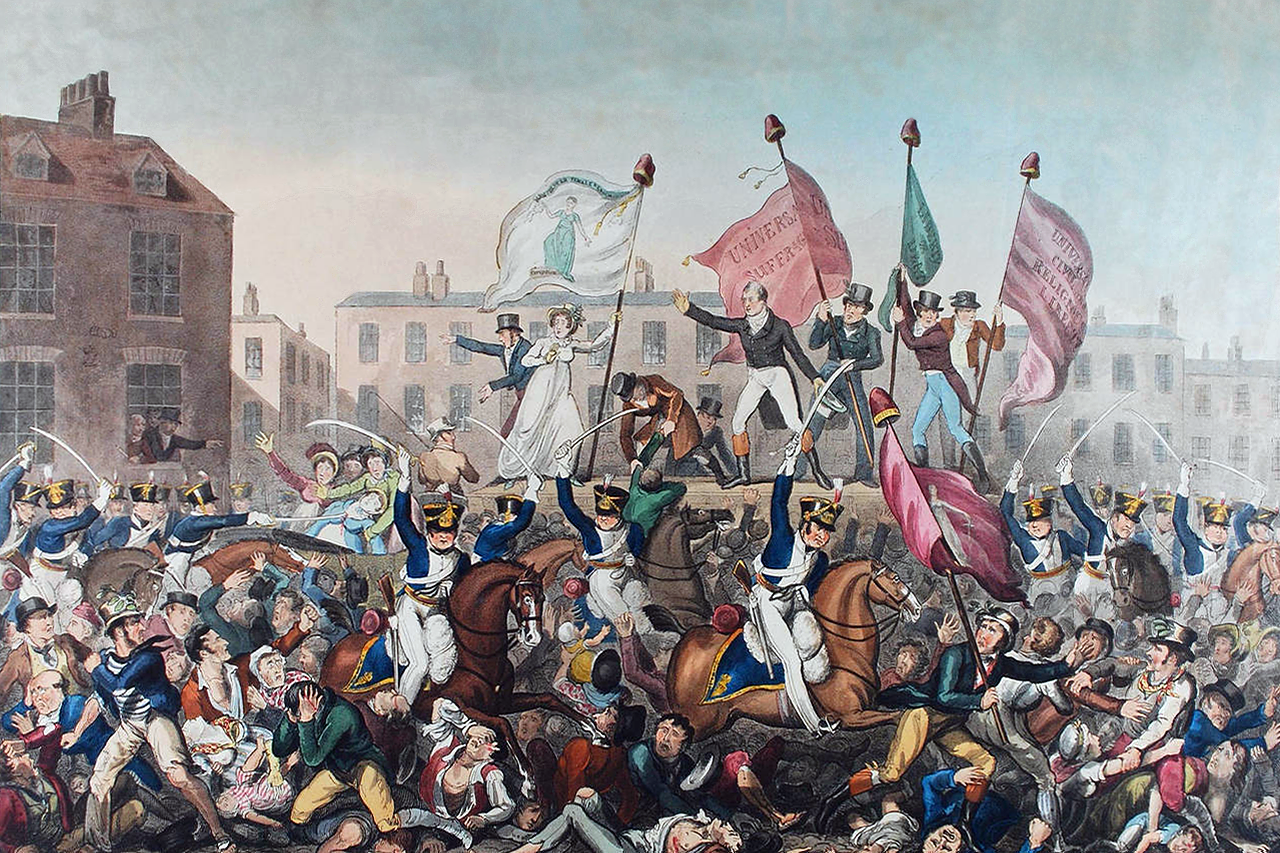
On 16th August 1819, at St. Peter's Field, on the outskirts of Manchester, a political meeting of 60,000 working men and women was dispersed by mounted dragoons, with a brutality that left eleven people dead and 421 cases of serious injury (including more than 100 women and children, and 162 individual cases of sabre wounds). The crowd had gathered to listen to Henry 'Orator' Hunt, an outspoken advocate of parliamentary reform. There were many families in attendance and there had been a picnic atmosphere prior to the attack. Like other towns and villages across the country, Manchester had grown in size since the start of the industrial revolution but the electoral constituencies had not been redrawn to reflect these shifting patterns of population. Some so-called 'rotten boroughs' were able to elect Members of Parliament with only a fraction of the votes of others. The Whigs were largely opposed to this inherently unfair system but still wanted to restrict the franchise to the propertied middle-class. The Tories were in favour of retaining the status quo. The people who attended this meeting were working-class and would not have benefited from any Whig reform. Their sympathies were with the radicals such as Hunt who wanted universal suffrage for all males over the age of 21, regardless of property. Such ideas were considered dangerously democratic by the ruling minority who arranged for the demonstration to be policed by armed 'yeomen' who attacked the crowd and arrested the speakers, leaving chaos in their wake.


After the demonstration reports were circulated and the event soon became national news. Along with the main speakers, the yeomen had also arrested a journalist from the London Times who, on his release, published a full account of what he had witnessed. It became known as the 'Peterloo Massacre' in reference to the horrors of the 1815 Battle of Waterloo. There is no doubt that the government saw the demonstrators as a threat to national security and they subsequently embarked on a massive campaign of repression to prevent any similar disturbances from occuring. The Romantic poet Percy Bysshe Shelley, travelling in Italy at the time, received news of the event within a week and was outraged by what had happened. In response he quickly composed one of the greatest political protest poems ever written, The Masque of Anarchy. When he sent the poem to his publishers however they were unwilling to have anything to do with it. The government had acted swiftly and taken repressive measures to clamp down on voices of opposition. [It was eventually published in 1832, ten years after Shelley's death, to coincide with the passing of the Reform Bill. In it he urges the masses to rise up and rebel. It is often seen as a key text in the formation of the idea of non-violent resistance and was a big influence on Gandhi in his 'civil disobedience' campaign against the British Empire.] Whilst they did not sympathise with the radicals' demands, moderate reformers were shocked by what had happened and scared by what could happen still. Amongst the witnesses of the massacre was John Edward Taylor who in 1821 founded a newspaper to promote liberal and middle-class interests, The Manchester Guardian.


The Reform Bill was passed in 1832, solving the problem of 'rotten boroughs' and making parliament more representative of a newly-industrialised society (where people tended to live in large towns and cities). However franchise was restricted to middle-class property owners and it would be many years before ordinary working people gained the right to vote. Ford Madox Brown did not include the Peterloo Massacre in his Manchester Murals because it was considered too controversial a political issue, representing as it did the idea of radical reform and universal suffrage. A commemorative blue plaque was later erected on the Free Trade Hall, now the Radisson Hotel, on Peter Street but its claim that the crowd had been 'dispersed' was considered too mild as it did not refer to the violent way way in which it happened (the killings were not even mentioned). As recently as 2007 a new red plaque was unveiled which refered to the event as a massacre and acknowleged the killings that had taken place. Nowadays it is widely referred to as Manchester's Tiannanmen Square.

The Ascent of Manchester: A Personal View

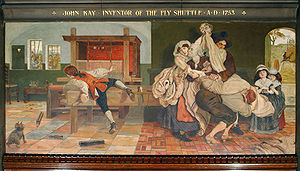
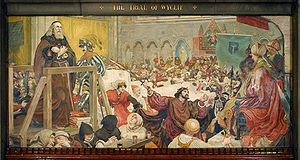
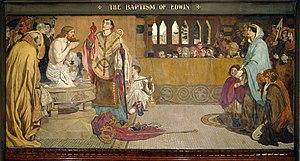
The Manchester Murals are a series of twelve paintings by the artist Ford Madox Brown representing the history of Manchester. They were painted between 1879 and 1893 and can still be seen at Manchester Town Hall. The story starts in 80 A.D. with the Romans building a fort and ends (in around 1800) with John Dalton collecting Marsh-Fire Gas.

DALTON COLLECTING MARCH-FIRE GAS

THE OPENING OF THE BRIDGEWATER CANAL A.D. 1761

JOHN KAY - INVENTOR OF THE FLYING SHUTTLE

BRADSHAW'S DEFENCE OF MANCHESTER A.D. 1642

CHETHAM'S LIFE DREAM A.D. 1640


CRABTREE WATCHING THE TRANSIT OF VENUS A.D. 1639

THE PROCLAMATION REGARDING WEIGHTS AND MEASURES A.D. 1556

THE TRIAL OF WYCLIFFE


THE ESTABLISHMENT OF FLEMISH WEAVERS IN MANCHESTER A.D. 1363


THE EXPULSION OF THE DANES FROM MANCHESTER

THE BAPTISM OF EDWIN

THE ROMANS BUILDING A FORT AT MANCENION A.D. 80


In 1969 the BBC commissioned a new TV documentary series to complement Kenneth Clark's landmark series Civilisation, an outline of Western art, architecture and philosophy. It was presented by Jacob Bronowski and it was called The Ascent of Man.

This blog, The Ascent of Manchester, is an outline history of one of the world's most important cities. It begins with the Peterloo Massacre, picking up from where Ford Madox Brown left off. Like the Manchester Murals, it is based around twelve events. The first six are:

  1. The Peterloo Massacre

  2. The Opening of Liverpool and Manchester Railway

  3. The Abolition of the Corn Laws

  4. Abraham Lincoln addressing the working people of Manchester

  5. The Opening of the Manchester Ship Canal

  6. The Geiger-Marsden Experiment

I will be posting the rest over the next couple of months. It is an unashamedly pro-Manchester history, intended to counter the negativity which with which people usually write or talk about the city. A good example is the widespread idea that the IRA 'did us a favour' in '96. With this in mind I have decided to end the project before 1996 to show that the Ascent of Manchester predates the bomb. The early '90s also has some personal resonance because it was the time when my own consciousness was raised about being a part of the city and its heritage – and it was also in 1992 that Francis Fukuyama published The End of History and the Last Man.