Sunday, 7 August 2011

Manchester bids for the Olympics A.D. 1993


Manchester United's 1990 FA Cup win is said to have saved Alex Ferguson his job. On 15th May 1991, Mark Hughes scored twice as United beat Barcelona 2-1 in Rotterdam to win the European Cup Winner's Cup with a starting line-up [Sealey; Blackmore, Pallister, Bruce, Irwin; Sharpe, Robson, Ince, Phelan; McClair, Hughes] which would be subject to several changes over the next few years. In 1992, Francis Fukuyama declared 'the End of History' in so far as the model of liberal democracy could not be improved upon, something which had been demonstrated dramatically in 1989 with the fall of the Berlin Wall and the collapse of the Soviet Union. Bill Clinton's election as President of the United States in 1992 had an end of history feel about it. Manchester seemed to be emerging from a dark period in its history after the pain of the Thatcher revolution, with a new light rail system, the Metrolink, opening in April 1992. Barcelona hosted the Olympic Games, something Manchester watched with interest as it too was bidding to host the Games in 2000 (after a failed bid to host the 1996 Games). The Barcelona Games were a huge success, showing what was possible in terms of boosting a postindustrial city's regeneration. The Football League had its moment of rebirth in 1992 as the first Premier League season (and the first Champions League) got underway with Sky Sports spending an unprecedented amount on TV rights, something which would change the face of the game.

The soundtrack for 1993 was New Order's Regret and James' Laid. Another Manchester band, the unsigned Oasis, got their big break in May when Alan McGhee, the owner of independent record label Creation, saw them play at King Tut's Wah Wah Hut in Glasgow. In the same month, Manchester United won the inaugural Premier League (25 years after George Best, Bobby Charlton and Nobby Stiles had helped them to win the European Cup), Peter Schmeichel and Eric Cantona having been added to the team that had won the Cup Winners Cup two years earlier. Ryan Giggs was awarded the PFA Young Player of the Year Award for the second year running. Boddingtons launched their iconic 'Cream of Manchester' advertising campaign with the phrase, "By 'eck, it's gorgeous!" On 24th September, thousands gathered in Castlefield to hear the results of the IOC's decision on who was to host the Olympics in 2000. Manchester made it to the third round of voting, ahead of Istanbul and Berlin but finished behind Beijing and eventual hosts Sydney. It was a better showing than Birmingham had managed in 1986 (for the 1992 Games) or Manchester itself in 1990 (for the 1996 Games). Ultimately not being awarded the Games didn't matter as it provided the basis for a successful Commonwealth Games in 2002 and inspired the city to think of itself as a rival to Barcelona. Perhaps not winning the games had a worse effect on Birmingham, which has since struggled to carve a niche for itself in the face of intense competition from both London and Manchester. Had it won the Games in 1992 instead of Barcelona (a big if, considering its poor performance), Birmingham would almost certainly have consolidated its second city status, probably attracting more investment away from London and increasing its international name recognition. As things stand, even Digby Jones has recently questioned Birmingham's second city status.

On 12th May 1994 it was announced that John Smith, the leader of the Labour Party, had died of a heart attack. As the debate began to centre around whether it would be Tony Blair or Gordon Brown who would challenge John Major's unpopular Conservative government at the next general election, Manchester United won the FA Cup for the eighth time, beating Chelsea 4-0 on 14th May with goals from Cantona (2), Hughes and McClair. The team had also retained the Premier League, making them the first United side to win the double. On 30th August, Oasis released Definitely Maybe, which became the fastest selling UK debut album ever. In his first conference speech as leader of the Labour Party, Tony Blair announced his intention to scrap Clause IV of the party's constitution, the commitment to nationalized industry. Oasis bridged the gap between albums by releasing their Christmas single Whatever, confirming their growing status as one of Britain's most popular bands.

On 25th January 1995 Eric Cantona, Manchester United's leading scorer from the previous season, was involved in a spectacular brawl with a Crystal Palace fan (leading to an eight-month ban) before telling a press conference that 'When the seagulls follow the trailer, it's because they think sardines will be thrown into the sea.' Blackburn Rovers would go on to win the third Premier League on the last day of the season after a closely fought campaign. During the summer of 1995, Robbie Williams was seen partying with Oasis at Glastonbury, shortly before his departure from Take That (who topped the singles chart with Back For Good and Never Forget). Oasis would lose to Blur in the high profile Battle of the Bands on 20th August as Country House outsold Roll With It but their second album What's the Story (Morning Glory)?, released in October, would go on to become one of the best-selling UK albums of all time. Simply Red achieved their first number single with Fairground. A legacy of the city's two unsuccessful Olympic bids, The NYNEX Arena opened on 15th July 1995 (later to become The M.E.N.). With a capacity of 23,000, it was (and remains) one of the biggest and most modern buildings of its kind in Europe. Also opened in 1995, Santiago Calatrava's Trinity Footbridge (linking the centres of Manchester and Salford, close to where the Lowry Hotel would be built) was a signal of intent, marking the start of a postmodernist architectural boom. On the opening day of the 1995-96 season, Manchester United lost 3-1 to Aston Villa with a young team that included Gary Neville, Nicky Butt, Paul Scholes, David Beckham (all aged 20) and Phil Neville (aged 18). With Paul Ince, Mark Hughes and Andrei Kanchelskis having been sold before the start of the season, Alan Hansen commented on Match of the Day that "You'll never win anything with kids." They ended the year ten points behind Newcastle.

United were able to close the gap before eventually becoming the first team to win the double twice, beating Liverpool in the FA Cup final on 11th May (Neville, Neville, Butt, Beckham and Scholes all making an appearance). Five days later, The Lightening Seeds released their song Three Lions against a backdrop of rising expectancy as England prepared to host Euro '96 (thirty years after their 1966 World Cup victory). In Manchester's case, football arguably was coming home as it was here that the Football League had been founded in 1888. With a capacity of around 55,000 at this stage, Old Trafford was one of the host venues and would host the semi-final between France and Czech Republic. Beforehand however, on the morning of Saturday 15th July 1996, parts of the city centre had to be evacuated after it was discovered that a bomb had been placed on Corporation Street between the Arndale Shopping Centre and Marks & Spencer. Although no-one was killed in the uncontrolled explosion at 11:20, hundreds of people were injured and millions of pounds worth of buildings were devastated in what was thought and later confirmed to be the work of the Provisional IRA. It came at an already uncertain time for the city centre's main shopping districts, as planning permission had finally been given to build The Trafford Centre (a huge shopping mall which would open in September 1998) on the western outskirts of the city with easier motorway connections than the city centre. In the immediate aftermath of the bomb, Council leader Richard Leese and Chief Executive Howard Bernstein travelled to London by train to request the money necessary to rebuild the city and were offered a show of support by Deputy Prime Minister Michael Heseltine, who suggested an international design competition which was won by Ian Simpson and resulted in Cathedral Gardens and Urbis (due to become the National Football Museum). As Manchester recovered from the trauma of the city centre bombing, a young David Beckham lobbed the goalkeeper from behind the halfway line on the opening day of the 1996-97 season, his first step on the road to global superstardom.

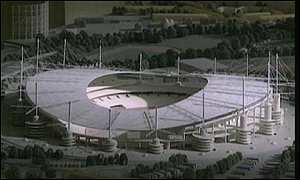
Manchester United would reach the semi-finals of the Champions League in 1997, losing to Borussia Dortmund (their best performance in the competition since winning it in 1968), and go on to win their fourth Premier League title in five years (having coming come very close to winning it in 1995). David Beckham won PFA Young Player of the Year as Eric Cantona announced his retirement. Eighteen years of Conservative government came to an end as the Labour Party won the 1997 General Election in May with 13.5m votes (63.4%). As the scale of the landslide became clear, incumbent Prime Minister Tony Blair addressed a jubilant crowd outside Royal Festival Hall: "A new dawn has broken, has it not?" For Manchester, it was beginning to seem like it had. The next ten years would see huge scale investment, culminating in the construction of the Beetham Tower in 2007 (at 169m the tallest building in the UK outside London). Manchester United would go on to win the Champions League in a dramatic 1999 final against Bayern Munich (as part of an historic treble). The 2002 Commonwealth Games coincided with the opening of the Imperial War Museum North in Salford Quays, Urbis, the City of Manchester Stadium (itself based on designs for the planned Olympic stadium of the failed 1993 bid) and Tadao Ando's concrete pavilion in Picadilly Gardens. 2002 also saw the release of Michael Winterbottom's film 24 Hour Party People, a look back at the story of Factory Records and The Hacienda. Control (2007) would look in more detail at the story of Ian Curtis and Joy Division, thirty years after the Buzzcocks had released Spiral Scratch. There was more circularity of a sort when Manchester United won the 2008 Champions League final, fifty years after the Munich Air Disaster and forty years after they had won the European Cup for the first time, history repeating itself.

Whilst Manchester has yet to (and probably never will) recover its musical prominence from the heady days of the late seventies through to the early nineties, it can occasionally throw up a band or a song to add to the canon. Elbow's June 2008 single One Day Like This is a classic example and provides the soundtrack to the closing stages of the Ascent of Manchester. United's 2008 Champions League win was probably more significant than the previous two, with a global TV audience (or 'reach') of up to 200m tuning in to see a new generation of stars, including Cristiano Ronaldo and Wayne Rooney, lift the trophy. It proved that the club could remain successful under the controversial new ownership of American businessman Malcolm Glazer. In September 2008, on the closing day of the summer transfer window, Manchester City were taken over by an oil-rich Abu Dhabi businessman and member of the royal family, Sheikh Mansour, whose half-brother is the current President of the United Arab Emirates (after whom Dubai's 828m Burj Khalifa was named). He has since ploughed money into the club who in 2011 won the FA Cup (their first trophy in 35 years) and qualified for the Champions League (for the first time) under Italian manager Roberto Mancini. The City of Manchester Stadium, a legacy of the Manchester 2000 Olympic bid, has been renamed The Etihad and the area around it (SportCity) is due to be transformed (after plans for the UK's only 'supercasino' were scrapped by Gordon Brown in February 2008). SportCity in the east of Manchester is complimented by MediaCity in Salford Quays to the west (near Old Trafford). In the south of the city, the Oxford Road corridor is the centre for M:KC (Manchester: Knowledge Capital), the publication of the 2008 RAE results confirming Manchester's status as the main rival to London, Cambridge and Oxford as a centre for UK Higher Education research. The city's centre of gravity is shifting southwards, not just because of the affluence of the Cheshire-based global footballing elite (who travel by train to Wembley direct from Stockport on the Pendolino).

We've mentioned SportCity, MediaCity and Knowledge Capital as three parts of Manchester's modern geography (East, West and South), all within the M60 ringroad. But perhaps the most important innovation lies just outside the M60. It is thought that John D. Kasarda's concept of the Aerotropolis, the urban area centred around the airport as the main hub for economic growth, will be the single most influential factor in the development of future cities. It's with this in mind that the development of Manchester's Airport City enterprise zone may help it to compete in the newly globalized economy, capitalising on its name recognition as one of the top footballing cities in Europe. If there was a thirteenth stage in the history of modern Manchester's development (following on from Peterloo; the Liverpool and Manchester Railway; the Abolition of the Corn Laws; the Lancashire Cotton Famine; the Manchester Ship Canal; the Rutherford Model; the Great Depression; the Small-Scale Experimental Machine; various achievements in drama, football and music, and an audacious bid for the 2000 Olympic Games) then perhaps it would be the arrival of the Airbus A380 at Manchester Airport on 1st September 2010, the world's largest passenger plane. Whilst British Airways has reduced its presence at Manchester (choosing to concentrate on an already overcrowded Heathrow), the three main Arabian carriers have decided to increase capacity on routes to and from the city. Globally connected, certainly better known throughout the world than most similar-sized cities through one (and now possibly two) of its football teams, Manchester still has a long way to go but is slowly establishing itself as the World City it dreamed of being when it bid for the Olympics in 1993. Having survived the rise and fall of Cottonopolis, the Ascent of Manchester, the world's first industrial city, is ongoing. There are huge challenges remaining [of the kind which make 'the End of History' a more relevant concept than people might first have thought] but there can be little doubt that Manchester is well-placed, indeed amongst the best-placed, to face them head on.

Thursday, 4 August 2011

Joy Division's Unknown Pleasures is released on Factory Records A.D. 1979

On 11th February 1975, Margaret Thatcher became Leader of the Opposition. The 1973 oil crisis had resulted in rising costs which led to union demands for wage increases and there was a sense that the good times were over. In 1976, the Sex Pistols played twice at the Lesser Free Trade Hall, signalling the arrival of punk rock in Manchester. In January 1977, The Buzzcocks self-released their Spiral Scratch EP. Produced by Martin Hannett, it was a minor chart success and demonstrated Manchester's emerging DIY ethic. The Sex Pistols' Nevermind the Bollocks..., released in October on Virgin, represented a more commercial approach. In May 1978, Granada TV presenter and Cambridge graduate Tony Wilson started putting on club nights in Hulme with Alan Erasmus under the name Factory (a reference to Manchester's industrial heritage). The winter of 1978-79 was to become known as the Winter or Discontent as unions went on strike and even the dead went unburied in Liverpool. Returning from a summit in the Caribbean in January 1979, prime minister James Callaghan tried to downplay the situation, leading The Sun to headline: 'Crisis? What Crisis?'
Joy Division's Unknown Pleasures was released in June 1979, the month after Margaret Thatcher had been elected Britain's first female prime minister with 13.7m votes (44%). Produced by Martin Hannett at Strawberry Studios, it was the first LP to be released on Factory Records, now based on Palatine Road in West Didsbury. Its dark sound reflected a darkening mood in the north of England at the time (1975-80 being the period of the Yorkshire Ripper), complimented by Peter Saville's sleeve design. In May 1980, as Joy Division were preparing to tour North America, singer Ian Curtis committed suicide. Ultimately this tragic moment resulted in increasing popularity for the band as their single 'Love Will Tear Us Apart', already a hauntingly beautiful song, became a chart success, as did their second album Closer. The remaining members of the band decided to carry on as New Order, with Bernard Sumner taking over vocal duties. In June 1981, as youth unemployment and racial tensions took their toll across the country, Moss Side became the latest inner-city area to erupt in mass riots, following on from the Brixton riots in April, and preceding the Toxteth (as well as Chapeltown and Handsworth) riots in July. A period of disenchantment seemed to be reflected in attitudes towards the city's architecture, with the Arndale Centre and the Hulme Crescents both coming to represent a cold, non-people-friendly austerity.

Factory Records had a forward-looking, civic-minded agenda so it was decided that profits from the sales of Joy Division and New Order's albums would go towards the creation of a new nightclub, based in a former warehouse building on Whitworth Street. Mike Pickering (who can be seen watching Manchester City with Noel Gallagher in the film Blue Moon Rising) was invited back from Rotterdam to book acts for the venue. It was to be called The Hacienda, based on a slogan from the situationist movement which had inspired Tony Wilson: '...the hacienda must built.' Punk rock had acted as a great leveller, demolishing everything that existed before, and now something had to be built in its place. Heavily influenced by the clubs in New York which Factory and New Order were now becoming familiar with, The Hacienda was to be a mixture between live music venue and nightclub, although it eventually came to be associated with DJ-only nights. The interior was designed by London-based Ben Kelly who used the distinctive yellow-and-black colour scheme which has since come to be closely associated with the club and the city itself. At a cost of £344,000, it came in way over budget (as had the Manchester Arndale Centre at £11,500,000), creating financial problems its owners were never fully able to overcome.

Modern, over-the-top, ahead of its time, The Hacienda was opened in May 1982, the same year as the formation of The Smiths. It was one of the first clubs to have no dress code. The emphasis here was to be on the music rather than fashion. In March 1983, New Order's Blue Monday was released. A dance classic, it was to become the biggest-selling 12-inch single of all time. The Smiths played at The Hacienda in July and the stage was strewn with flowers, with singer Morrissey describing the iconic Manchester venue as "sterile and inhuman". In January 1984, Madonna made her first UK TV appearance on The Tube, performing at The Hacienda. A month later, The Smiths released their debut album, the first of four to be released over a four-year period. In the miners' strike of 1984, Lancashire miners were not as militant as their Yorkshire counterparts but it was a period of conflict and hardship nonetheless. July 1986 saw Factory Records organize the Festival of the Tenth Summer (it being the tenth summer since the Sex Pistols had played their seminal gigs the Lesser Free Trade Hall), with The Fall, The Smiths and New Order playing at the G-Mex (an exhibition centre based in the building which had housed the Manchester Central train station). In November, Alex Ferguson was appointed manager at Manchester United, beginning a reign that was to outlast that of fellow Scotsman Matt Busby. The club had won the FA Cup in 1983 and 1985 (reaching the semi-finals of the European Cup Winners' Cup in 1984) but had not won the league since 1967.

The summer of 1988 was known in Manchester as the second summer of love (a term which also covers the summer of 1989), with ecstasy becoming popular amongst club-goers and The Hacienda in particular becoming a centre for the new genre of Acid House (symbolised by the yellow smiley face). Whilst the drug-fuelled euphoria of the period is seen as a highpoint for the club (and the city itself), it also marked the beginning of its demise. Sales of alcohol decreased and gangs started causing trouble on the door and inside the venue as guns gained prominence, making young men from inner-city areas like Salford, Cheetham Hill and Moss Side effectively untouchable. The Stone Roses released their debut album in 1989 (since described by the NME as the greatest British album ever) and played at Spike Island in May 1990, the month New Order released World in Motion, the band's only number one single. On 4th July, England lost on penalties to West Germany in the semi-finals of the World Cup, the furthest they had gone in the tournament since winning it in 1966. The Happy Mondays released their album Pills n Thrills and Bellyaches (which contained the single Step On) on 27th November 1990. The next day, Margaret Thatcher left 10 Downing Street for the last time as Prime Minister. It was an exciting moment for a city that stood on the verge of greatness but still had a lot of problems to overcome.

Monday, 1 August 2011

Manchester United become the first English team to win the European Cup A.D. 1968


On completion in 1962, The CIS Building was the tallest building in the UK and, at 118m, the third tallest in Western Europe. By a strange quirk of fate, the top two belonged to cities whose teams had beaten Manchester United in the semi-finals of the European Cup. The tallest was the Torre de Madrid (1957, 142m) which, standing alongside the Edificio Espana (1953, 117m) overlooking the Plaza de Espana, was a dominant symbol of Franco's Spain. The second tallest was the Pirelli Building (1960, 127m) near Milan's Central Station, still one of Europe's most elegant skyscrapers. In the area covered by today's European Union, the Palace of Science and Culture (1955, 231m) in Warsaw, a symbol of Stalin's influence in the Eastern Bloc, would have dwarfed all of them. The Cuban Missile Crisis took place in the same year as the completion of the CIS Tower and served as a reminder of the climate of fear that surrounded the politics of the Cold War, when the threat of nuclear armageddon still seemed a very real possibility.


In 1960, the year of the first episode of Coronation Street, a rock n roll group from Liverpool decided to change their name to The Beatles. In June 1962 they changed their line-up: John Lennon (guitar), Paul McCartney (bass), George Harrison (lead guitar), Ringo Starr (drums). In July 1962, Denis Law signed for Manchester United from Torino for 115,000, a British transfer record. In March 1963, The Beatles released their debut album Please Please Me, which went straight to number one. In September 1963, George Best made his Manchester United debut, aged 17, as Harold Wilson spoke of a Britain that was going to be forged in "the white heat of the technological revolution". The first episode of Top of the Pops was broadcast on 1st January 1964 from the BBC's Manchester Studios in Rusholme. Denis Law won the Ballon d'Or (European Footballer of the Year award) in the same year and The Beatles released their third studio album, A Hard Day's Night. In 1965, George Best appeared on TOTP as Manchester United won their sixth league title and with The Beatles releasing Help! and Rubber Soul.

1966 was an important year for British music and football. Manchester United were in their third European Cup and, on 9th March, they beat Benfica 5-1 away to reach their third semi-finals (which they would go on to lose to Partizan Belgrade). The scorer of the first two goals, George Best was dubbed "O Quinto Beatle" by the Portuguese press. As England was preparing to host the 1966 World Cup, Manchester group The Hollies released their single 'Bus Stop', written by Graham Gouldman who would go on to to form 10CC. Brought up in Collyhurst, Manchester United's Nobby Stiles was to play a decisive role in England's World Cup campaign, playing in front of the back four. His performance against Portugal in the semi-finals was particularly important as he man-marked Eusabio out of the game. After winning the World Cup, Bobby Charlton became the second Manchester United player to win the Ballon d'Or. In the music world, The Beatles released Revolver and The Twisted Wheel nightclub moved to Whitworth Street, kickstarting 'Northern Soul'.

Manchester United won their seventh league title in 1967, the same year The Beatles released Sgt. Pepper's Lonely Heart Club Band, and in March 1968 they beat Gornik Zabrze to progress to their fourth European Cup semi-finals in as many tournaments. On 13th May, the last day of the season, Manchester City won their second league title (with a team featuring Mike Sumerbee, Colin Bell and Francis Lee), two points ahead of second place Manchester United. Two days later, United faced one of their toughest challenges, taking a 1-0 lead to the Bernabeu. In front of a crowd of 125,000, they earned a 3-3 draw against Real Madrid to reach their first European Cup final. On 29th May, they beat Benfica 4-1 (after extra time) at Wembley to win the tournament, ten years after the Munich Air Disaster, the first English side to do so. They joined an illustrious list of teams in having won the tournament: Real Madrid (6), Benfica (2), Internazionale (2), Celtic (1), Milan (1). Of the other English teams to have played in the tournament, two had reached the quarter finals (Wolverhampton Wanderers in 1960 and Burnley in 1961) and two had reached the semi finals (Tottenham Hotspur in 1962 and Liverpool in 1964). The Beatles released The White Album in November and, in December, George Best became the third Manchester United player to win the Ballon d'Or.

The success of The Beatles in this period frames the rise of George Best, the 'fifth Beatle'. Much more than Denis Law and Bobby Charlton (his fellow Ballon d'Or winners), Best represents the spirit of the age, the birth of the celebrity footballer and possibly the icon of the permissive society itself. As well as providing a cautionary tale about the dangers of excess, the story of his downfall in the 1970s perhaps reflects a wider darkening mood of disillusionment after the highs of the late 1960s. There are other similarities between Best and The Beatles, relevant to The Ascent of Manchester. They both moved from their hometown at a young age to pursue their careers in a bigger city and it was in their adopted homes that they invested the money they earned. George Best opened nightclubs and fashion boutiques in Manchester at a time when TOTP and The Twisted Wheel were also putting the city on the musical map. Peter Hook's The Hacienda: How not to run a club describes how The Beatles shaped attitudes of Manchester's next generation:


One thing that was certain and propaganda-free was the collective desire to give something back to Manchester, to inject something into the city - whatever that something might turn out to be. All were horrified by The Beatles model: you made it, go to London and spend your money there. The Beatles' Apple HQ on Savile Row was the antithesis of the Factory way.


'The difference is Manchester,' said [Tony] Wilson. '10CC, for example, made a load of cash and built Strawberry Studios in the early 1970s, so when Factory came on stream we had an international recording facility just around the corner from us. Similarly, New Order make a pile of money and together with a load of other people they're able to build the Hacienda...'


Hook 2009 (24)


The Beatles are often cited as the band that made Liverpool great (or something to that effect), but if we think about it, they really belonged to London - in the same way that George Best belonged to Manchester. The relatively much less successful 10CC did so much more for Manchester than The Beatles did for Liverpool by investing their earnings back into the city. But this should come as no surprise. Manchester in the 1960s had, for a time, the fourth tallest building in Europe; the nation's most-watched TV programme (Coronation Street); TOTP; three winners of the Ballon d'Or and the most successful English football team in Europe; Northern Soul. New Order were to show a similar (if slightly misplaced) loyalty to their hometown in the 1980s. But there were tough times ahead for the city, as the post-war consensus began to fall apart.

Friday, 29 July 2011

The first performance of Shelagh Delaney's A Taste of Honey A.D. 1958


By 1958, Britain had become a net importer of cotton cloth. This was obviously a moment of transition, a tipping of the scales, for the city once known as 'Cottonopolis'. Whether it was due to importing or exporting goods (and it seemed increasingly to be the former), this was also the golden era for the Manchester Liners and tonnage handled by the Manchester Ship Canal Ports reaches its peak around this time. Matt Busby's Manchester United team were also going from strength to strength. Having won their second FA Cup in 1948, they won the league in 1952, 1956 and 1957 (for the third, fourth and fifth time). The team that managed to retain the league title were nicknamed 'the Busby Babes' on account of their average age of 22. In 1956 they were the first English team to play in the European Cup, beating Anderlecht 10-0 on 26th September at Maine Road in front of a crowd of 43,600. The next home match was better attended, with 75,000 watching them beat Borussia Dortmund 3-2 in October. A 3-0 victory over Atletico Bilbao in February saw them reach the semi-finals, where they lost to Alfredo Di Stefano's Real Madrid, the holders and eventual winners, who consistently drew crowds of 100,000 - 120,000 at the Bernabeu.


The age of football as a mass spectator sport had truly arrived and the 'Busby Babes' were becoming household names. Football was not the only thing bringing Europe closer together: the European Coal and Steel Community (formed in 1945) became the European Economic Community in 1958 (both forerunners of the European Union). The Suez Crisis in 1956 had reduced Britain's influence as a global power, affecting its attitude towards its European neighbours and their increasing measures of economic co-operation. The period also saw the introduction of the cheap package holiday with charter flights to Spanish holiday resorts making overseas travel affordable for the first time, something which was to have a devastating impact on British seaside towns like Blackpool. By 1958, Manchester Airport was handling 500,000 passengers annually, a figure which was to rise significantly over the coming years, with Tenerife, Mallorca, Alicante, Malaga and Lanzarote all becoming popular destinations.


Tragedy hit the city when on 6th February 1958 it was reported that the Manchester United team plane had crashed on the runway in Munich when attempting to take off in freezing temperatures. The Busby Babes were returning home after a 3-3 away draw with Red Star Belgrade had seen them through to a second European Cup semi-final in as many years. Eight players died in what was to become known as the Munich Air Disaster, including a 21-year-old Duncan Edwards, widely regarded as one of the best players in the game and a future England captain. Widespread newspaper coverage of the event increased its significance and triggered an emotional public response, similar to that of the death of Princess Diana in 1997. The club founded 80 years earlier as the works team of a Newton Heath railway depot who had risen to become one of the top clubs in Europe would from now on be associated with the wreckage of an airplane in the snow of Munich. That the team were able to rebuild was a credit to people such as Matt Busby and Bobby Charlton, who both survived the crash, in what remains one of the most powerful stories in world sport.


The 1957-58 season wound to an understandably difficult close for Manchester United. On 3rd May they lost to Bolton Wanderers in the final of the FA Cup. On 8th May they beat A.C. Milan 2-1 at home in the first leg of the European Cup semi-finals but lost the return leg 4-0 at the San Siro on 14th May. On 27th May, A Taste of Honey opened at the Theatre Royal in Stratford, East London, before transferring to the West End on 10th February 1959 for a long run. Its writer, Shelagh Delaney, was representative of a group of dramatists who became known as the Angry Young Men. This was despite the fact that she was wasn't male, nor was she particularly angry. She was however incredibly young and this may have been a factor in her early success. Born in 1939, Delaney grew up in working class Salford, failed the 11-plus and left school at 15, without going to university. When she was 18, she saw a production of Terence Rattigan's Variation on a Theme. Thinking she could do better, she wrote the play which which was accepted by Joan Littlewood's Theatre Workshop Company which had its roots in Manchester in 1945 (one of its founders Ewan MacColl had decided to pursue his folk music interests instead). The Angry Young Men aimed to represent the lives working-class and lower middle-class ordinary people, for whom life was a struggle. It was a conscious rejection of contemporary theatre and the carefree, affluent lives of the characters it portrayed. The classic example of the new movement was John Osbourne's Look Back in Anger (1956), set in the Midlands. Set in Salford, A Taste of Honey is about single parent families, interracial relationships and teenage pregnancy. Despite being poor, its characters do not berate their luck or seek to blame anyone and for this reason it might have been called 'Don't Look Back in Anger'. Walter Greenwood's Love on the Dole (1933) was an angry novel. Whilst not being light-hearted by any stretch of the imagination, A Taste of Honey (1958) did deal with some serious issues but had more in common with what was to become Britain's longest running soap opera and a national institution.


Made by Granada Studios and set in Weatherfield, a fictional town based on Salford, the first episode of Tony Warren's Coronation Street was broadcast on 9th December 1960. A columnist for the Daily Mirror claimed that the series would only last three weeks. The show came to be defined by its setting, a row of red-brick terraced housing centred on the local pub (the Rovers Return); its theme music, a cornet piece accompanied by a brass band; and its dialogue, which was unrelentingly fast-paced and littered with dialect words and phrases that gradually came to be associated with the city and the soap. During its heyday in the 1960s-1980s, the show could regularly rely on viewing figures of over 20 million, making it one of the most popular programmes on TV and a huge commercial success for its broadcasters. Its most watched episode came on 25th December 1987 when Hilda Ogden left the Street. With an audience of 26,650,000 this remains one of the most watched television broadcasts in British history. Unlike its main rival Eastenders (which started in 1985, is set in East London and seen as being grittier), Coronation Street has always retained an air of camp fun. There has been a backlash recently and the soap is generally thought to have entered a long period of decline, perhaps as much a reflection on changing viewing habits as its increasingly over-the-top storylines and poor scriptwriting. In the context of the early '60s however there are few better representations of how Manchester saw itself and how it was seen by others. Here, Ena Sharples and Elsie Tanner argue about a letter.

Thursday, 28 July 2011

The Small-Scale Experimental Machine ('Baby') A.D. 1948


On 1st September 1939 Hitler invaded Poland, prompting Britain and France to declare war on Nazi Germany. Hundreds of thousands of children from Manchester and Salford were evacuated to the relative safety of the surrounding countryside. As one of the largest industrial estates in Europe, Trafford Park was turned over to war production, with Rolls Royce, Avro and Metropolitan-Vickers making the engines and aircraft required by the RAF. Its strategic importance made the area a target for air raids by the Luftwaffe, the most devastating of which took place on the nights of 22nd and 23rd December 1940. Whilst the industrial areas around Old Trafford, Stretford and Salford bore the brunt of the bombing, damage was reported from as far afield as Prestwich and Chorlton. Around 650 people died in the attacks, with over 2,000 injured and 6,000 made homeless. As Nazi propaganda declared that the entire city had been burnt to the ground, King George VI and Winston Churchill visited to assess the damage.

Elected in the landslide election of 1945 with 12,000,000 votes (50%), Clement Atlee's post-war Labour government nationalised the coal and steel industries and created the National Health Service. 'Austerity Britain' relied heavily on loans from the United States as it sought to re-build its damaged infrastructure. Large-scale immigration from the British Empire began in this period (from Hong Kong, the Indian subcontinent and the Carribean), adding to Manchester's already cosmopolitan mix of Irish and Jewish enclaves in the north and south of the city. Polish and Ukrainian immigrants also arrived as Stalin's Russia began to assert itself in Eastern Europe. The growing instability of the British Empire was reflected in the highly influential 5th Pan-African Congress, held in Chorlton-on-Medlock Town Hall in October 1945, which led to the decolonization of Africa, and further political if not economic independence for its newly independent nations.

On 19th February 1945, Matt Busby, a 36-year-old Scotsman and practising Catholic who had played for Manchester City and Liverpool in the 1930s, was appointed manager of Manchester United and given an unprecented level of control over team selection, player transfers and training sessions. Playing their home games at Maine Road, Old Trafford having been severely damaged in the Manchester Blitz, United came second in the league in 1947 and won the FA Cup in 1948, beating Blackpool 4-2 in the final to gain their first trophy in 37 years. In the same year, a proposed extension to Sunlight House on Quay Street was rejected by the planning committee. At 35 floors, this imposing 110m skyscraper would have been the tallest building in Europe but was felt to be unsympathetic to a city still rebuilding itself after the devastation of World War II. If post-war 'Austerity' Manchester was scaling back its architectural ambitions, then the year 1948 would also see a major technological revolution which would have a global impact in the years to come.

Based on mathematician and former Bletchley Park cryptanalyst Alan Turing's pioneering work on algorithms and computation, the Small-Scale Experimental Machine (nicknamed 'Baby') ran its first program on 21st July 1948 at Manchester University in which it took 52 minutes to find the highest proper divisor of 2^18. Designed as a testbed for the Williams tube, an early form of Random Access Memory (or RAM), the SSEM was the world's first stored-program computer. Whilst Turing was based at Manchester from September 1948 until his death in 1954 and did contribute towards and make use of its successors, the SSEM was built by a team led by Manchester graduates Frederic Williams and Tom Kilburn (an avid Man United fan). It was to form the basis for the Manchester Mark I (1949) and the Ferranti Mark I (1951), the world's first commercially available general-purpose computer.


There is a memorial in Sackville Park to Alan Turing who as well as being widely regarded as the father of computer science was also an early patron of Manchester's Gay Village at a time when homosexuality was still illegal. His death at his home in Wilmslow from Cyanide Poisoning in June 1954 was returned as a suicide verdict and followed a conviction for indecency in 1952. Next to his body was a half-eaten apple. Unveiled in 2001, the Turing statue in Sackville Park has him sitting at a bench holding an apple in his right hand. Regardless of how we interpret the apple as a symbol, what is clear is that there is a strand linking Turing with the latest developments in computer technology, for example Apple's iPad (2010) which is displayed alongside the replica SSEM at Manchester's Museum of Science and Industry. Barack Obama recognised this link in his historic 2011 speech to both Houses of Parliament: '...from Alan Turing to Steve Jobs, we have led the world in our commitment to science and cutting-edge research.' Manchester's role in the dawn of the computer age was small but significant. It came as Asian and Far Eastern countries, sources of seemingly unlimited cheap labour, were becoming more and more competitive in the textile industry. Manchester's challenge over the next fifty years was to diversify away from textiles and re-invent itself as a dynamic postindustrial economy in an increasingly globalized world.

Tuesday, 26 July 2011

L.S. Lowry paints Coming from the Mill A.D. 1930


'Daily Express is right! Taint bin same since War' (Love on the Dole, 1933)


1913 - the year Manchester-based physicist Niels Bohr formulates the Bohr model and suffragette Emily Davison is killed after running in front of the King's Horse at the Epsom Derby - is also the peak year for British cotton cloth production, co-inciding with the end of Britain's 'imperial century' (1815 - 1914). On 28th June 1914, Archduke Franz Ferdinand, the heir to the throne of the Austro-Hungarian empire is assassinated in Sarajevo by a Yugoslav nationalist. The event sparks a Great War between Europe's empires, the first to use modern machinery on the battlefield to such a large extent. As the young men of Britain's industrial towns and cities are marched to the trenches of the Western Front, women are put to work in the factories (proving how easy it is to operate the machinery that would soon be making more and more male workers redundant in the years to come).


Whilst Manchester had had its peaks and troughs, the inter-war years are a period of steady decline. In May 1926, the TUC announced a general strike 'in defence of miner's wages and hours' which was to last nine days. The Wall Street Crash of October 1929 signalled the start of a global period of depression which would last until the outbreak of the Second World War. In 1930, Salford's L.S. Lowry painted Coming From the Mill, his first of many oil paintings depicting Britain's industrial north and what Howard Jacobson has described as 'scurrying humanity'. To appreciate the painting's visual representation of movement and the relationship between people and the urban environment, we should read from Walter Greenwood's Love on the Dole (1933), with its main character Harry Hardcastle,


proceeding, via by-streets, to fall in with a great procession of heavily
booted men all wearing overalls and all marching in the same direction ... the
air resounded with the ringing rhythmic beat of hobnailed boots ... an
entrancing tune, inspiring, eloquent of the great engineering works where this
army of men were employed ... Three huge chimneys challenged the lowering sky;
three banners of thick black smoke gushed forth from their parapets, swirling,
billowing, expanding as they drifted, with 'imperturbed pace' to merge
imperceptibly into the dirty sky. A docile row of six smaller chimneys thrust up
their steel muzzles like cannon trained on air raiders. Tongues of flame shot
up, fiery sprites, kicking their flaming skirts about for a second then diving
again as instantly as they had appeared. An orange glow reflected dully on the
wet slates of the foundry.

In Coming From the Mill we see people on their way home from work in the shadow of an imposing, industrial skyline. Lowry's 'matchstick men' have been described as 'naive', the works of a 'Sunday painter' but there can be few of these which now fetch up to £5.6m at auction. Booker Prize winner Howard Jacobson has written about the proud, provincial loneliness of L.S. Lowry, a painter whose works are now kept on display in a purpose-built art gallery and theatre complex on Salford Quays named in his honour. Lowry is to Manchester what Gaudi is to Barcelona, what Mucha is to Prague and what Klimt is to Vienna. There can be few examples of a closer relationship between an artist and his city.


After leading a long-running campaign of civil disobedience and a boycott of British goods in India, Mahatma Ghandi visited Britain in 1931 for talks with the British government. During his stay, he visited a cotton mill in Darwen and was well-received by the unemployed workers on whom his policies were perceived to be having such a devastating effect. He also visited C.P. Scott, the editor of the Manchester Guardian, at his sister's home in Bognor Regis. Manchester was going through its own form of non-violent resistance in this period. The Mass Trespass of Kinder Scout of April 1932 (a year which also saw the construction of Sunlight House) is celebrated in the song 'The Manchester Rambler' by Ewan MacColl, one of the event's organisers. Rambling in Derbyshire was a popular past-time amongst Manchester's left-wing activists. Away from the factories and the slums and the poverty of industrial Salford, the Derbyshire peaks must have seemed an idyllic escape, at for those who could afford the train fare. In Love on the Dole, Greenwood has Harry's sister fall in love with a Marxist who takes her rambling in Derbyshire with his friends from the Labour club, but she feels herself to be 'greatly inferior' to them:


It was as though they belonged to a different species. Somehow she identified them as people who could afford pianos and who could play them; people who lived in houses where there were baths. Their conversation, too, was incomprehensible. When the talk turned on music they referred to something called the 'Halley' where something happened by the names of 'Baytoven' and 'Bark' and other strange names. They spoke politics, arguing hotly about somebody named Marks. Yes, they were of a class apart, to whom the mention of a pawnshop, she supposed, would be incomprehensible. Suppose they saw her home; her bedroom! She blushed, ashamed.


Published in 1933, the year Adolf Hitler became Chancellor of Germany with over 17,000,000 votes (43.9%), Love on the Dole is set in Hanky Park, an industrial district of Salford, and documents the human scale of the Great Depression. Whilst it can be interpreted in many ways, not least as a forerunner of Coronation Street (offering a window into the lives of a working class community in the back-to-back terraced streets of Salford) or a literary accompaniment to Lowry, it is perhaps best read as an example (perhaps the only example) of 1930s Manchester modernism. After resigning as a clerk and signing as an engineering apprentice for seven years, Harry Hardcastle soon realises that machinery is making skilled operatives more and more dispensible:


Remember the installation of that new automatic machinery previous to the wholesale dismissal of Billy Higgs's generation? At that time it had held no significance for him except that it had meant promotion; it was merely newer and more up-to-date machinery whose functions were marvellous, whose capacity was manifold and infinite. The screw-cutting lathe that needed only the assistance of a hand to switch on the current: that could work, ceaselessly, remorselessly, twenty-four hours a day, seven days a week without pause for meals; a Thing that fed itself, functioned with mathematical precision, 'could do anything except talk', as someone had put it.
The novelty of such machinery was gone now; they were commonplace, established; their predecessors were antidilluvian. They made of inexperienced boys highly skilled men. And the latest boys knew of nothing else; were as to the manner born.
Every year new generations of schoolboys were appearing, each generation pushing him and his a little closer to that incredible abyss of manhood and the dole.


Such fears were nothing new. They echo the Lancashire Loom Breakers Riots of 1826, over a hundred years earlier. But whilst previously rich and poor had co-existed, modern transport developments now allowed the inventors and industrialists who profitted from the efficiency of the new machinery (at the expense of the people whose jobs they were superseding) to quit the city for suburban and rural areas on the outskirts. The theme of all the rich folk moving away from 'Millionaire's Mile' on Eccles Old Road haunts Love on the Dole like memories of World War I. Modernity is represented as bringing prosperity to the few and widespread misery to the masses of newly unemployed.


In 1934, Manchester City won the FA Cup for the second time and work was completed on another of Manchester's most iconic buildings, Central Library. Ten years after an ineffectual General Strike, the Jarrow March of 1936 was a reminder of rising inequality and mass unemployment. 1936 also saw the abdication crisis of Edward VIII and the coronation of his brother as George VI (events represented recently in the film The King's Speech), and the start of a football season, 1936-37, in which Manchester City won their first league title. Painted in 1937, the same year as Picasso's Guenica and George Orwell's The Road to Wigan Pier, L.S. Lowry's The Lake is a bleak indictment of the industrial revolution and the ideas of human progress upon which Manchester was seemingly built. Jacobson has described it as 'apocalyptic'. These were uncertain times - despite scoring more goals than any other team in the division, reigning champions City were relegated in 1938 - but there was widespread relief when British Prime Minister Neville Chamberlain returned from negotiations in Munich with Nazi Germany, France and Italy, declaring a settlement of the Czechoslovakian problem and an agreement which he believed represented 'peace for our time'.

Friday, 8 July 2011

The Geiger-Marsden Experiment A.D. 1909


Manchester was the world's first industrial metropolis. In the years 1800 – 1900, its population grew from 89,000 to 1,435,000, making it the ninth largest city in the world (Chandler 1987). As the list below shows, it was also the largest city in Europe which wasn't an imperial capital:


  1. London (6,480,000)

  2. New York (4,242,000)

  3. Paris (3,330,000)

  4. Berlin (2,707,000)

  5. Chicago (1,717,000)

  6. Vienna (1,698,000)

  7. Tokyo (1,479,000)

  8. St. Petersburg (1,439,000)

  9. Manchester (1,435,000)

  10. Philadelphia (1,414,000)


The empires of Europe (Great Britain, France, Germany, Austria-Hungary and Russia) were about to enter into war with each other in the years 1914 – 1918. Manchester was never again to achieve such prominence. By contrast, the Ruhr's population grew from 766,000 (1900) to 4,900,000 making it the world's ninth biggest city in 1950. Note also that Chicago's population has increased to around the 5,000,000 mark in the same year:


  1. New York (12,463,000)

  2. London (8,860,000)

  3. Tokyo (7,000,000)

  4. Paris (5,900,000)

  5. Shanghai (5,406,000)

  6. Moscow (5,100,000)

  7. Buenos Aires (5,000,000)

  8. Chicago (4,906,000)

  9. Ruhr (4,900,000)

  10. Kolkata (4,800,000)


The 1950 list reflects a shift away from the major European powers (of whom only Britain, France and Germany remain). America and Japan have strengthened their positions. China, the Soviet Union (as Russia had then become known), Argentina and India are new additions. The lists show that whilst Manchester would keep on growing it wouldn't keep up with the expansion of other world cities. So the twenty year period between the opening of the Manchester Ship Canal and the start of the First World War can be seen as the peak of the city's global status.

This is demonstrated when we look at some of the events that were taking place in Manchester and around the world during the first half of the year 1904: On 30th January, Salford Lads Club is opened by Robert Baden-Powell; on 19th February, Winston Churchill makes an important speech on Free Trade at the Manchester Free Trade Hall (the home of the Hallé Orchestra); on 17th February, Giacomo Puccini's Madame Butterfly premieres at La Scala in Milan; on 23rd April, Billy Meredith scores the only goal of the game as Manchester City beat Bolton Wanderers 1-0 to win the FA Cup for the first time; on 4th May 1904, car manufacturer Henry Royce was introduced to motoring and aviation pioneer Charles Rolls at the Midland Hotel in Manchester.

The Suffragette movement has its origins in Manchester during this period. On 10th October 1903 the Women's Social and Political Union was founded by Emmeline Pankhurst at her house in Chorlton-on-Medlock. On 13th May 1905 Sir Edward Grey, a leading member of the Liberal Party, came to Manchester to deliver a speech at the Free Trade Hall. The event was attended by Christabel Pankhurst and Annie Kennie. They asked the speakers at the meeting if women would be allowed to vote but their questions were ignored so they created a disturbance in order to get themselves arrested. The incident achieved widespread publicity and is seen to mark the start of a long-running campaign of 'direct action' to focus attention on the issue of women's suffrage. Political progress towards a fair system of electoral representation (universal suffrage), a movement that had arguably begun in Manchester with the Peterloo Massacre of 1819, was matched by scientific progress. The story of the Manchester Physics department in the years 1900 – 1913 befits the kind of place that had pretensions of being the ninth biggest city in the world, not only a city of warehouses and commodity exchanges or a global shipping hub but one of the world's most important centres for scientific discovery.

The idea of the atom was first proposed by Manchester's John Dalton in around 1805 so it's perhaps no surprise that the city would go on to play such a hugely important role in the later stages of the development of atomic theory. J.J. Thomson was born in Cheetham Hill in 1856 and took a great interest in science as a child. He was admitted to Owens College in 1870 at the age of just fourteen before moving on to Cambridge where he became Cavendish Professor of Physics in 1884. Arthur Schuster was born in Frankfurt am Main in 1851 and moved to Manchester with his family in 1870. He also went to Owens College (Manchester) and spent five years at Cavendish (Cambridge) before returning to Owens in 1881, now Manchester University, where he was appointed Chair of Physics in 1888. [To make clear – we have Schuster (the German) at Manchester and J.J. Thomson (from Manchester) at Cambridge.] Born in 1871, Ernest Rutherford (pictured above right), moved to England from New Zealand to do postgraduate study at Cavendish (Cambridge) from 1895 – 1898, before moving to Montreal, Canada, where he was to do the work that would win him the Nobel Prize for Chemistry in 1908.

In 1897 J.J. Thomson discovered the electron (at Cavendish – where Rutherford was a postgraduate student at the time). This led him to formulate the 'plum pudding' model of the atom in 1904, where electrons were seen as being randomly distributed in a sphere of positive charge. As Chair of Physics at Manchester, Schuster established an active research department and designed a new laboratory which, when it was opened in 1900, was the fourth largest in the world and would soon become a serious rival to Cavendish. Schuster resigned in 1907 but had ensured that Rutherford would take over from him. German physicist Hans Geiger (pictured above left), born in 1882, also joined the Manchester department at this time and, in 1908, Rutherford and Geiger invented a device that would later become known as the Geiger counter (used for detecting radioactive emissions).

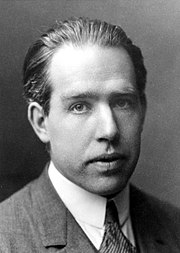
In 1909, Hans Geiger worked with Ernest Marsden, an undergraduate from Rishton in East Lancashire, to conduct the Geiger-Marsden experiment (or Gold foil experiment), under the supervision of Ernest Rutherford. It was the first successful attempt to probe the structure of the atom, revealing the existence of the atomic nucleus. It disproved the 1904 'plum pudding' model, devised by J.J. Thomson (the Manchester-born, Cambridge-based physicist who had discovered the electron in 1897). Rutherford's interpretation of the data from the Geiger-Marsden experiment led him to formulate the Rutherford model of the atom in 1911 which states that a very small positively charged nucleus is surrounded by electrons. This is also called the planetary model because of the way the electrons orbit the nucleus. Danish physicist Niels Bohr (pictured above centre), born in 1885, was to theorize the orbit of the electrons when he joined Rutherford's department at Manchester in 1912 (the same year Geiger moved to Berlin). Adapting Rutherford's nuclear structure to Max Planck's quantum theory, Bohr formulated the Bohr model in 1913 which was to lay the foundation for quantum mechanics.

Under Rutherford's direction, the Physics department at Manchester had made huge advances in atomic theory and Rutherford was knighted in 1914. In a poetic twist, the undergraduate who'd taken part in the experiment that had revolutionized our understanding of the nature of the atom, Ernest Marsden moved to New Zealand in 1915 (Rutherford's home country), where he'd been recommended for a Professorship in Physics at one of the universities. After four productive years at Manchester, Niels Bohr returned to Copenhagen in 1916 [and was to become one of the founders of CERN in 1954]. In 1917 Rutherford himself left the department to take over his old teacher J.J. Thomson's role at Cavendish [where, in the early 1930s, Cockroft and Walton were the first to artificially 'split' the atom, using particle accelerators]. He died in 1937 and is interred in Westminster Abbey alongside J.J. Thomson and near to Sir Isaac Newton.